


When most people picture an African safari, they imagine the open golden plains of the Serengeti, a dust cloud trailing behind a herd of wildebeest, or a lion draped languidly across a sun-warmed rock. It is a powerful image — and it is only part of the story.
Africa is far larger, far more complex, and far more astonishing than any single landscape can represent. And nowhere on the continent makes that case more convincingly than Uganda.
Positioned at the geographic heart of Africa, Uganda is the continent’s most biologically diverse safari country. Within its relatively compact borders — roughly the size of the United Kingdom — it contains tropical rainforests older than civilisation, savannah plains teeming with lions and elephants, crater lakes of impossible blue, and the mist-wrapped highland forests where nearly half of the world’s remaining mountain gorillas quietly go about their ancient lives.
An African safari in Uganda is not a variation on a familiar theme. It is something fundamentally different: more intimate, more layered, more emotionally resonant than the classic East African safari circuit. It is a journey into one of the last places on earth where human beings can sit in quiet proximity to a wild gorilla, watch a tree-climbing lion survey its domain from a fig branch, or hear the Victoria Nile thundering through a seven-metre crack in the earth’s surface.
This is the definitive guide to experiencing an African safari in Kenya and Uganda — the parks, the wildlife, the planning essentials, and everything that makes this country one of the most profound travel destinations on earth.
Uganda’s Place in the African Safari Landscape
The African safari industry is dominated, commercially and culturally, by a handful of names: the Masai Mara, the Serengeti, the Okavango Delta, Kruger National Park. These are extraordinary places, and their reputations are deserved. But they share certain characteristics that Uganda does not: large visitor volumes, heavily trafficked game-viewing circuits, and an experience that, for all its magnificence, can feel curated.
Uganda operates differently. Its national parks receive a fraction of the visitors that descend annually on Kenya or Tanzania. Its game drives unfold without convoys of safari vehicles converging on every lion sighting. Its gorilla treks are limited to eight visitors per family group per day — a restriction that is simultaneously a conservation measure and an experiential gift to the traveller fortunate enough to hold a permit.
What Uganda offers, above all else, is authenticity. The wildlife here is wild. The forests are genuinely impenetrable in places. The silences are real silences. And the encounters — with gorillas, chimpanzees, lions, elephants, shoebill storks — carry a weight and immediacy that is difficult to replicate in more heavily visited destinations.
Uganda’s ecological diversity is the engine of all this. The country straddles the Albertine Rift — one of the world’s most significant biodiversity hotspots — and encompasses habitats ranging from open savannah to ancient montane forest. This diversity of environment produces a corresponding diversity of wildlife, making Uganda arguably the most complete safari destination in Africa:
- Over 1,080 bird species — more than any other African country
- 13 primate species, more than any comparably sized territory on earth
- Approximately 500 mountain gorillas, nearly half the global wild population
- The Big Five distributed across multiple national parks
- Hundreds of mammal species across ten national parks and twelve wildlife reserves
The National Parks: Uganda’s Safari Heartland
Bwindi Impenetrable National Park
No discussion of an African safari in Uganda begins anywhere other than Bwindi. This UNESCO World Heritage Site in southwestern Uganda is one of Africa’s oldest forests — a biological treasury that has survived ice ages, climatic upheaval, and millennia of change while maintaining an ecological complexity that continues to astonish researchers.
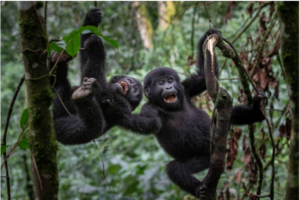
Bwindi’s fame rests on its mountain gorillas. Approximately 500 individuals — organised into more than 50 family groups — inhabit the park’s 331 square kilometres of ancient highland forest. Roughly half of these families have been habituated to human presence through years of patient ranger work, making them accessible for guided trekking.
The gorilla trek is the defining African safari experience that Uganda owns exclusively at this scale. Groups of eight visitors, guided by expert Uganda Wildlife Authority rangers, enter the forest at dawn and follow trackers who have located the gorilla family overnight. The trek may take one hour or eight, through terrain that demands physical commitment. And then, without ceremony, the forest opens and a gorilla is simply there — a silverback resting against a tree root, a mother nursing her infant in a shaft of filtered light, juveniles tumbling over each other in play.
The sixty-minute visit passes in something close to suspended time. Veteran travellers with decades of safari experience routinely describe it as the single greatest wildlife encounter of their lives. That assessment is rarely an exaggeration.
Permits cost USD 800 per person and should be secured six to twelve months in advance. The fee funds gorilla conservation and supports communities living along the park boundary.
Murchison Falls National Park
Uganda’s largest national park stretches across 3,840 square kilometres of northwestern wilderness, defined by the spectacle that gives it its name. At Murchison Falls, the entire volume of the Victoria Nile — one of the world’s great rivers — forces itself through a rock gap less than seven metres wide before plunging 43 metres in a detonation of white water and mist. Standing at the crest of the falls, with the river roaring beneath your feet and rainbows forming in the spray, is one of Africa’s genuinely unmissable natural experiences.
The park’s wildlife is exceptional. Lions, leopards, elephants, buffaloes, hippopotamuses, and Rothschild’s giraffes — one of the rarest giraffe subspecies on earth — share the landscape with over 450 bird species. The boat safari from Paraa to the base of the falls is a highlight of any Uganda itinerary: a slow, wildlife-rich cruise past pod after pod of hippopotamuses, enormous Nile crocodiles hauled out on sandbanks, and — for the patient and the fortunate — the unmistakable silhouette of the shoebill stork, a bird so ancient in appearance it seems to belong to another geological era.
Queen Elizabeth National Park
Straddling the equator in western Uganda, Queen Elizabeth and Bwindi forest National Park is a landscape of sweeping scenic grandeur and exceptional wildlife density. The park encompasses open savannah, dense forest patches, volcanic craters, and the shores of two Rift Valley lakes connected by the Kazinga Channel — a 32-kilometre natural waterway that hosts one of the highest concentrations of hippos and Nile crocodiles anywhere in Africa.
The Kazinga Channel boat safari is essential. Buffalo herds drink at the water’s edge. Hippos submerge and resurface with enormous, indifferent authority. Fish eagles scream from waterside trees. African skimmers trace the surface at dusk. It is wildlife viewing at its most immediate and most abundant.
The park’s Ishasha sector in the south is home to one of Africa’s most unusual wildlife spectacles: tree-climbing lions. Here, prides of lions habitually rest in the branches of giant fig trees — a behaviour documented in only two locations worldwide. Watching a pride arrange themselves through a canopy with the ease of animals entirely at home in the world is a safari moment that lingers long after the photograph is taken.
Kibale National Park
Kibale National Park is the primate capital of Africa. Home to 13 primate species and the continent’s highest density of primates per square kilometre, Kibale’s centrepiece experience is chimpanzee tracking. Habituated communities of chimpanzees allow visitors to observe natural behaviours at close range — territorial calling, social grooming, foraging, and the complex hierarchies that govern chimp society — in a forest that is itself a marvel of biodiversity.
Combined with a visit to the Bigodi Wetland Sanctuary, a community conservation project on Kibale’s edge, a day here can deliver sightings of red colobus monkeys, grey-cheeked mangabeys, L’Hoest’s monkeys, and over 200 bird species in a single guided walk. It is a day that demonstrates, more vividly than any other, why Uganda’s biodiversity per square kilometre is unmatched on the continent.
The Cultural Dimension of a Uganda Safari
An African safari in Tanzania and Uganda is enriched by a human and cultural depth that distinguishes it further from purely wildlife-focused destinations. The Batwa Experience in Bwindi introduces visitors to the ancestral knowledge of the Batwa pygmies — the original forest inhabitants displaced by the park’s creation — through guided forest walks that convey generations of understanding about medicinal plants, traditional hunting, and forest navigation.
In western Uganda, the Banyankole cattle-herding culture, the royal traditions of the Buganda Kingdom around Kampala, and the vibrant craft markets of Kabale and Fort Portal offer a cultural richness that rewards the curious traveller. Uganda’s food, its music, its extraordinarily welcoming people — these are not peripheral to the safari experience but integral to it.
Essential Planning Information
When to Visit
The long dry season (June–September) is the most popular time to visit, offering reliable trekking weather, navigable forest trails, and excellent game viewing. The short dry season (December–January) is similarly favoured and less congested than the mid-year peak.
The green seasons (March–May and October–November) bring fewer visitors and dramatically lush scenery. Birdwatching is at its finest during these periods, when migratory species join Uganda’s resident avifauna. Some remote roads become challenging, but the atmosphere of solitude can be extraordinary.
Getting There
International arrivals land at Entebbe International Airport on the shores of Lake Victoria. Regular connections run from Nairobi, Kigali, Addis Ababa, Dubai, Amsterdam, and London. Safari transport within Uganda is by 4×4 land cruiser. Domestic charter flights to airstrips at Pakuba (Murchison Falls), Kasese (Queen Elizabeth), and Kihihi (Bwindi) offer significant time savings on compact itineraries.
Health Requirements
A valid yellow fever vaccination certificate is mandatory for entry into Uganda. Malaria prophylaxis is essential. Comprehensive travel insurance including emergency evacuation cover is strongly recommended for all visitors.
Accommodation
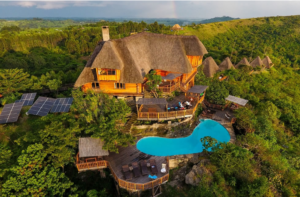
Uganda’s safari accommodation ranges from ultra-luxury wilderness lodges to well-run community guesthouses. Flagship properties such as Clouds Mountain Gorilla Lodge near Bwindi and Chobe Safari Lodge at Murchison Falls combine extraordinary locations with high levels of comfort and sustainability commitment. Mid-range lodges in all park areas deliver excellent value. Budget travellers are well served by bandas and tented camps throughout the safari circuit.
Key Takeaways
- An African safari in Congo and Uganda is defined by intimacy and biodiversity — fewer crowds, more species, and wildlife encounters of rare emotional intensity.
- Uganda hosts approximately 500 mountain gorillas, nearly half the global wild population, making gorilla trekking at Bwindi Impenetrable National Park the most sought-after safari experience in Africa.
- Over 1,080 bird species have been recorded in Uganda — more than any other country on the continent, and a compelling reason to bring binoculars regardless of primary interests.
- Gorilla trekking permits cost USD 800 per person and must be reserved months in advance; they are the single most important booking in any Uganda safari itinerary.
- Four national parks — Bwindi, Murchison Falls, Queen Elizabeth, and Kibale — form the core safari circuit and collectively deliver savannah, forest, wetland, and Rift Valley wildlife experiences.
- Uganda’s dry seasons (June–September and December–January) offer optimal conditions for trekking and game drives; wet seasons offer exceptional birdwatching and solitude.
- Cultural experiences including the Batwa pygmy forest walks and Buganda Kingdom heritage add a human dimension that enriches the safari beyond wildlife alone.
- Uganda’s conservation model works: mountain gorilla populations have tripled since the 1980s through community-centred conservation funded in significant part by responsible tourism revenue.
Frequently Asked Questions
Q: How does an African safari in Uganda compare to Kenya or Tanzania?
A: Kenya and Tanzania excel at open savannah game viewing, particularly around the Masai Mara and Serengeti ecosystems. Uganda offers something complementary rather than competing: unrivalled primate experiences, denser ecological diversity, significantly fewer visitors, and the unique emotional weight of gorilla trekking. Many experienced Africa travellers rate Uganda as their most profound safari destination precisely because it delivers experiences impossible to replicate elsewhere.
Q: What is the success rate for seeing gorillas during a trek?
A: The gorilla sighting success rate in Bwindi is consistently above 95%. Uganda Wildlife Authority trackers locate the gorilla family on the morning of the trek before visitor groups enter the forest, significantly improving the likelihood of a sighting. On the rare occasions when a family moves unexpectedly, rangers make every effort to locate them. Refunds or rebooking are handled on a case-by-case basis.
Q: What level of fitness is required for a Uganda safari?
A: Fitness requirements vary by activity. Gorilla trekking is the most physically demanding — treks can last up to eight hours through steep, wet terrain, and a reasonable level of cardiovascular fitness is important. Chimpanzee tracking in Kibale is moderately demanding. Boat safaris and game drives require no physical exertion. Porters are available at all trekking parks and are both practically useful and economically important to local communities.
Q: How many days should I allocate for a Uganda safari?
A: A focused itinerary covering gorilla trekking at Bwindi and a game drive or boat safari experience at Queen Elizabeth or Murchison Falls requires a minimum of seven to nine days. A comprehensive itinerary incorporating Bwindi, Kibale, Queen Elizabeth, and Murchison Falls comfortably fills twelve to fifteen days. Adding a cross-border gorilla experience at Rwanda’s Volcanoes National Park extends this by two to three days and is an outstanding combination for primate enthusiasts.
Q: Is a Uganda safari suitable for solo travellers?
A: Uganda is an excellent destination for solo travellers. Most reputable safari operators offer join-in group departures that allow solo visitors to share costs and company. The intimate scale of wildlife experiences — gorilla treks capped at eight people, chimpanzee groups similarly small — means solo travellers integrate naturally into the experience. Uganda’s warm and genuinely hospitable culture makes independent travel between destinations manageable for those with a spirit of adventure.
Conclusion
An African safari in Uganda is, in the end, an argument about what travel is for.
If travel is about ticking destinations and accumulating experiences, there are faster and more efficient ways to see African wildlife. But if travel is about being genuinely moved — about standing in a primordial forest and understanding, viscerally and without intellectual mediation, that you are sharing this planet with creatures of extraordinary intelligence and beauty — then Uganda makes a case for itself that no amount of Serengeti spectacle can fully answer.
The mountain gorillas of Bwindi carry their own gravity. The falls at Murchison carry their own thunder. The tree-climbing lions of Ishasha, the chimpanzees of Kibale, the shoebill storks drifting over the papyrus swamps of the Nile delta — each is a reminder that Africa’s biological inheritance is still, against all odds and in defiance of all pressures, largely intact in Uganda’s protected areas.
That inheritance is not accidental. It is the product of decades of conservation commitment, community partnership, and the revenue generated by every visitor who chooses Uganda over a more familiar destination. When you book an African safari in Rwanda and Uganda, you are not simply buying an experience. You are contributing to one of the most important conservation success stories in the world.